
Nikon F4 Instruction Manual: A Comprehensive Guide
Embark on mastering your Nikon F4 with this complete user manual, covering installation, operation, and maintenance; please retain this guide carefully․
Welcome to the world of professional photography with the Nikon F4! This flagship 35mm film SLR, released in 1988, represents a pinnacle of Nikon’s engineering․ This instruction manual serves as your comprehensive guide to unlocking the F4’s full potential․ It’s designed for both seasoned professionals and those venturing into the realm of film photography․
The Nikon F4 boasts advanced features like a sophisticated metering system, versatile autofocus capabilities, and robust build quality․ Understanding these features is key to achieving exceptional results․ This manual will walk you through every aspect of the camera, from initial setup and film loading to advanced exposure techniques and troubleshooting․ Prepare to explore a camera that blends classic film photography with cutting-edge technology, offering a truly rewarding photographic experience․
Unboxing and Initial Setup

Upon receiving your Nikon F4, carefully inspect the box for any signs of damage during shipping․ Inside, you should find the camera body, a strap, and potentially some original documentation․ Before inserting batteries, visually inspect the camera’s exterior for any cosmetic imperfections․
To begin, install 4 AA batteries into the battery compartment located at the bottom of the camera․ Ensure correct polarity! Next, attach the strap securely to the provided loops․ Power on the camera and verify the LCD panel illuminates․ Familiarize yourself with the basic layout of buttons and dials․ It’s recommended to set the date and time for accurate EXIF data if using compatible lenses․ Your Nikon F4 is now ready for film and photographic adventures!
Understanding the F4’s Body and Controls
The Nikon F4 boasts a robust, professional-grade body designed for durability and comfortable handling․ Key controls are intuitively placed for efficient operation․ The top deck features the main command dial for shutter speed adjustment, the exposure compensation dial, and the ISO setting dial․

The rear panel houses the LCD display, providing crucial shooting information․ Buttons control metering mode selection, autofocus operation, and drive mode․ The viewfinder offers a bright, clear view with focus indicators․ A dedicated lever switches between autofocus and manual focus․ Understanding the function of each button and dial is crucial for mastering the F4’s capabilities and achieving optimal photographic results․
Film Loading and Unloading
Proper film loading and unloading are essential for preserving your images and the camera’s functionality․ Begin by opening the camera back using the film release lever․ Insert the 35mm film cartridge into the film chamber, ensuring it seats correctly․ Thread the film leader onto the take-up spool, advancing it a couple of frames․
Close the camera back securely․ The frame counter will automatically begin incrementing as you advance the film․ To unload, press the film rewind button and turn the rewind crank until the film is fully retracted․ Open the camera back and carefully remove the film cartridge․ Avoid exposing the film to direct sunlight during loading and unloading to prevent damage․
Metering Modes Explained
The Nikon F4 offers versatile metering modes to suit various shooting scenarios․ Understanding these modes is crucial for achieving accurate exposures․ The camera provides Spot, Center-Weighted, and Matrix metering options․ Spot metering measures light from a very small area, ideal for challenging lighting or specific subject isolation․
Center-Weighted metering prioritizes the center of the frame while considering the entire scene․ Matrix metering, Nikon’s evaluative mode, analyzes the entire frame to determine the optimal exposure․ Selecting the appropriate mode depends on the scene’s complexity and your desired creative outcome․ Experimenting with each mode will enhance your photographic control․
Spot Metering and its Applications

Spot metering on the Nikon F4 excels in situations demanding precise exposure control․ It measures light from a remarkably small area – approximately 2․25° – allowing you to expose specifically for your subject, irrespective of background brightness․ This is invaluable when photographing subjects against strongly contrasting backgrounds, like a portrait against a bright sky․
To utilize spot metering, select the appropriate mode and aim the spot indicator at the crucial area of your subject․ The F4 will base its exposure solely on that reading․ Mastering spot metering unlocks creative possibilities, ensuring your subject is perfectly exposed, even in difficult lighting conditions․ Practice is key to refining this technique․
Center-Weighted Metering
Center-weighted metering on the Nikon F4 provides a balance between simplicity and accuracy․ It prioritizes the light reading from the center of the frame, gradually decreasing sensitivity as you move towards the edges․ This mode is exceptionally versatile for everyday photography, particularly when your subject occupies the central portion of the composition․
The F4’s center-weighted metering is ideal for landscapes or portraits where the main subject is centrally located․ It’s less susceptible to being fooled by bright or dark areas in the periphery compared to full matrix metering․ While not as precise as spot metering, it offers a reliable and convenient option for a wide range of shooting scenarios, delivering consistently good results․
Matrix Metering
The Nikon F4’s Matrix Metering system represents a significant advancement in exposure calculation․ It analyzes the entire frame, dividing it into segments and comparing the light levels across each․ This allows the camera to determine the most appropriate exposure based on a complex algorithm, considering scene type and lighting conditions․
Matrix metering excels in challenging situations like backlit subjects or scenes with high contrast․ It’s particularly effective for general photography where precise control isn’t paramount․ However, it’s crucial to understand that Matrix metering can sometimes be misled by unusual lighting or strong background elements․ For critical shots, verifying the exposure with other modes is recommended, ensuring optimal results․
Focusing System: A Detailed Look
The Nikon F4 boasts a sophisticated focusing system, offering both autofocus and manual focus capabilities for diverse shooting scenarios․ Its autofocus system utilizes five focus points, strategically positioned across the frame, allowing photographers to select the optimal point for their subject․ The camera provides various autofocus modes, including single-servo (AF-S) for stationary subjects and continuous-servo (AF-C) for tracking moving objects․
Achieving sharp images relies on selecting the appropriate autofocus mode and focus point․ The F4’s manual focus is exceptionally precise, aided by a split-image microprism collar in the viewfinder, facilitating critical focus adjustments․ Mastering both systems unlocks the F4’s full potential․
Autofocus Modes and Settings
The Nikon F4 offers a range of autofocus (AF) modes to suit various photographic situations․ Single-servo AF (AF-S) is ideal for still subjects, locking focus when the shutter button is half-pressed․ Continuous-servo AF (AF-C) excels at tracking moving subjects, continuously adjusting focus as they move within the selected focus point․
Additionally, the F4 features autofocus-area modes, allowing you to choose between single-point AF, dynamic-area AF (using multiple points), and closest-subject priority AF․ Fine-tuning AF sensitivity is also possible, adjusting how quickly the camera responds to subject movement․ Understanding these settings is crucial for consistently sharp results․
Manual Focus Precision
Achieving critical focus with the Nikon F4 in manual mode requires practice and attention to detail․ The camera’s bright viewfinder and split-image focusing screen aid in precise adjustments․ Rotate the focusing ring on the lens until the subject appears sharpest in the viewfinder; utilize magnification if needed for fine-tuning․
For challenging situations, like low light or macro photography, careful observation is key․ Remember to confirm focus before releasing the shutter․ The F4’s depth-of-field preview button allows visualizing the area in focus at the selected aperture․ Mastering manual focus unlocks creative control and ensures sharpness when autofocus isn’t optimal․

Exposure Control: Aperture, Shutter Speed, and ISO
The Nikon F4 offers comprehensive control over exposure, balancing aperture, shutter speed, and ISO for desired results․ Aperture (f-stop) dictates depth of field – lower numbers for shallow focus, higher for greater depth․ Shutter speed controls motion blur; faster speeds freeze action, slower speeds allow for creative blur․
ISO determines the film’s sensitivity to light; lower ISOs for bright conditions, higher ISOs for low light․ The F4’s metering system assists in suggesting appropriate settings, but manual control allows for artistic interpretation․ Understanding the interplay between these three elements is crucial for achieving properly exposed photographs․
Advanced Features: Depth of Field and Hyperfocal Distance
The Nikon F4 empowers photographers to master depth of field (DoF) and hyperfocal distance for precise focus control․ DoF, influenced by aperture and focal length, determines the in-focus area․ Smaller apertures (higher f-numbers) yield greater DoF, ideal for landscapes․
Hyperfocal distance is the focus point achieving maximum DoF; everything from half that distance to infinity appears acceptably sharp․ The F4 doesn’t calculate this automatically, requiring manual computation or use of a DoF scale․ Utilizing these techniques allows for intentional creative control, ensuring critical elements are sharply rendered within your images․
Using the Nikon F4 with Different Lenses
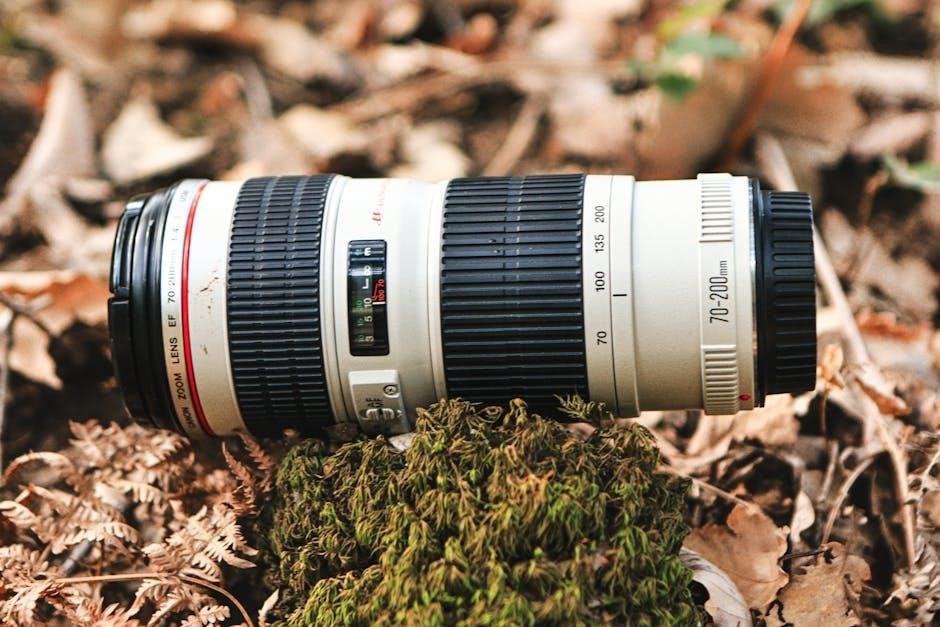
The Nikon F4 boasts compatibility with a vast array of Nikon F-mount lenses, offering versatility for diverse photographic pursuits․ Both AI and AI-S lenses function seamlessly, providing full aperture control․ Older non-AI lenses require an adapter ring for proper mounting and operation, though some functionality may be limited․
When switching lenses, ensure the camera body and lens mount are clean to prevent damage․ The F4 automatically detects supported lens features, like maximum aperture․ Experimenting with different focal lengths and apertures unlocks creative potential, adapting the camera to various shooting scenarios – from wide-angle landscapes to telephoto wildlife photography․
Troubleshooting Common Issues
Encountering issues with your Nikon F4 is infrequent, but understanding potential problems ensures swift resolution․ A common concern is the LCD displaying error codes; consult the manual’s dedicated section for specific meanings and suggested fixes․ If the shutter fails to release, check battery levels and ensure the lens is correctly mounted․
Battery issues often stem from prolonged storage or using incompatible batteries․ Always use recommended lithium batteries for optimal performance․ If autofocus malfunctions, verify the autofocus mode setting and lens compatibility․ Regularly cleaning the camera’s contacts can also resolve intermittent errors․
Error Codes and Their Meanings
The Nikon F4 utilizes error codes displayed on the LCD to indicate specific malfunctions, aiding in quick diagnosis․ “Err 1” typically signals a problem with the film advance mechanism, potentially requiring professional servicing․ “Err 2” often relates to shutter speed errors, suggesting a possible issue with the electronic shutter control․
“Err 3” can indicate a communication failure between the camera body and a connected lens․ Regularly cleaning the lens contacts can often resolve this; Other codes may relate to battery voltage, memory card errors (if using a back), or internal system failures․ Always consult the full error code list within the Nikon F4 instruction manual for precise interpretations and recommended solutions․
Battery Issues and Solutions
The Nikon F4 primarily uses CR123A lithium batteries, known for their reliability but susceptible to performance decline in extreme temperatures․ A common issue is low battery warnings appearing prematurely; ensure fresh batteries are used, and avoid mixing old and new ones․ If the camera fails to power on, verify correct battery polarity and clean the battery contacts with a soft, dry cloth․
Persistent battery drain may indicate an internal fault requiring professional attention․ Avoid prolonged storage with batteries installed, as leakage can occur․ Consider carrying spare batteries, especially during extended shooting sessions․ Refer to the Nikon F4 instruction manual for detailed battery specifications and troubleshooting steps․

Maintenance and Care of Your Nikon F4
To ensure the longevity of your Nikon F4, regular maintenance is crucial․ Gently blow away dust from the camera body and lens mount using a blower; avoid using compressed air, which can damage internal components․ Clean the viewfinder and focusing screen with a soft, lint-free cloth․ Always consult the Nikon F4 instruction manual for specific cleaning recommendations․
Store the camera in a dry, dust-free environment, ideally in a camera bag․ Avoid exposing it to extreme temperatures or humidity․ Periodically check the battery compartment for corrosion․ Professional cleaning and servicing are recommended every few years to maintain optimal performance․ Handle with care, and avoid dropping or subjecting the camera to impact․
Nikon F4 Specifications

The Nikon F4 is a professional-grade 35mm SLR camera renowned for its robust build and advanced features․ It boasts a focal plane shutter with speeds from 30 seconds to 1/8000th of a second, and flash sync at 1/250th second․ The camera accepts Nikon F-mount lenses․ Refer to the Nikon F4 instruction manual for a complete lens compatibility list․
It features a five-area Multi-CAM autofocus system and offers spot, center-weighted, and matrix metering modes․ The F4 utilizes standard 35mm film and accepts six AA batteries․ Dimensions are approximately 154․5 x 10⁴․5 x 75 mm, with a weight of around 975g (without batteries or lens)․ Its ISO range is 6-6400, providing versatility in various lighting conditions․

Resources and Further Learning
To deepen your understanding of the Nikon F4, several resources are available beyond this instruction manual․ Online forums dedicated to classic Nikon cameras, like Photo․net and Nikonians, offer valuable insights and user experiences․ Consult the Nikon F4 instruction manual for detailed diagrams and explanations․
Vintage camera websites often host scanned versions of original manuals and supplementary materials․ YouTube channels specializing in film photography frequently feature tutorials and reviews of the F4․ Consider exploring books on advanced photography techniques to fully utilize the camera’s capabilities․ Remember to always cross-reference information and practice regularly to master the Nikon F4’s features․